Jupiter Moons
|
|
|
|
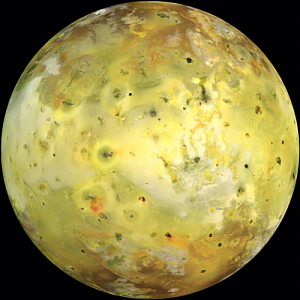
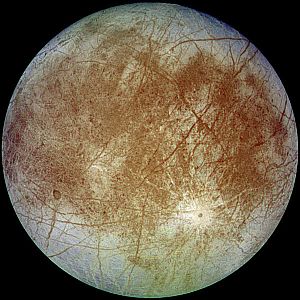
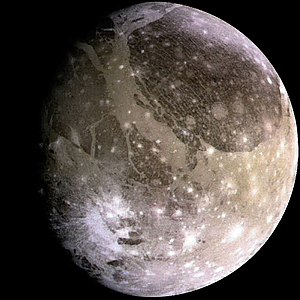
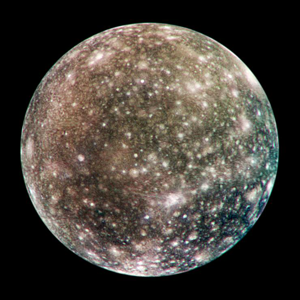
Jupiter is the fifth planet from our Sun and is, by far, the largest planet in the solar system – more than twice as massive as all the other planets combined. Jupiter's stripes and swirls are actually cold, windy clouds of ammonia and water, floating in an atmosphere of hydrogen and helium. Jupiter’s iconic Great Red Spot is a giant storm bigger than Earth that has raged for hundreds of years. Jupiter is surrounded by 79 known moons. Scientists are most interested in the Galilean satellites – the four largest moons discovered by Galileo Galilei in 1610: Io , Europa, Ganymede and Callisto. Jupiter also has several rings, but unlike the famous rings of Saturn, Jupiter’s rings are very faint and made of dust, not ice. Jupiter is named for the king of the ancient Roman gods.
With a radius of 43,440.7 miles (69,911 kilometers)ont , Jupiter is 11 times wider than Earth. If Earth were the size of a nickel, Jupiter would be about as big as a basketball. From an average distance of 484 million miles (778 million kilometers), Jupiter is 5.2 astronomical units away from the Sun. One astronomical unit (abbreviated as AU) , is the distance from the Sun to Earth. From this distance, it takes Sunlight 43 minutes to travel from the Sun to Jupiter.
Jupiter has the shortest day in the solar system. One day on Jupiter takes only about 10 hours (the time it takes for Jupiter to rotate or spin around once) , and Jupiter makes a complete orbit around the Sun (a year in Jovian time) in about 12 Earth years (4,333 Earth days). Its equator is tilted with respect to its orbital path around the Sun by just 3 degrees . This means Jupiter spins nearly upright and does not have seasons as extreme as other planets do.
|
|
|
|
|
|